
Topographic Survey Basics for Homeowners and Developers
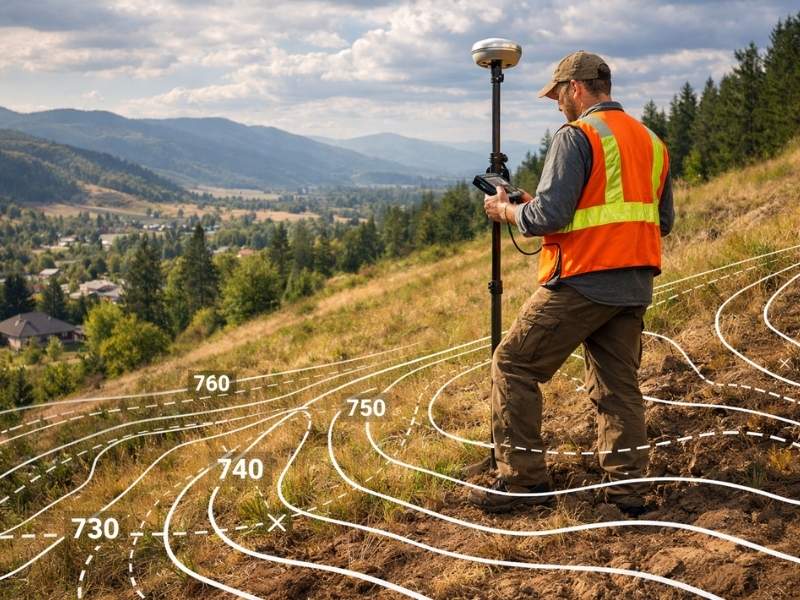
A lot of projects hit problems during design or permitting that a topographic survey would have prevented. The land looks flat until you get the actual elevations and find a two-foot drop across the build area. Drainage looks simple until the survey shows water flows straight toward the foundation. A topographic survey gives you the real picture of a site before any money gets spent on design or construction. This article covers what it is, what it shows and when you need one.
What a Topographic Survey Shows
A topographic survey measures the elevation and physical features of a piece of land. It captures hills, slopes, low spots, drainage paths and existing structures. It also records trees, fences, utilities and other features that affect how a site can be developed.
The output is a map with contour lines. Each line connects points at the same elevation. The spacing between lines tells you how steep the terrain is. Lines close together mean a steep slope. Lines far apart mean a gentle grade.
Engineers and architects use topographic survey data as the base for all site design work. Without it, grading plans, drainage designs and foundation layouts are built on guesses.
Why Elevation Data Changes Everything
A site that looks level from the street can have significant grade changes across it. Those changes affect where a structure can sit, how water drains off the property and how much grading work a project will require.
Grading costs money. A lot of it. Finding out during construction that a site needs more cut and fill than expected is one of the most common budget problems on development projects. A topographic survey reveals that before anyone breaks ground.
Drainage is the other big issue. Water has to go somewhere. If a site drains toward a foundation or toward a neighbor’s property, that’s a problem. A topographic survey shows exactly where water flows so engineers can design around it before permits are pulled.
What Gets Captured in a Topographic Survey
The level of detail in a topographic survey depends on the project. Most surveys capture the following:
- Ground elevations across the entire site at regular intervals
- Existing structures and their locations relative to the terrain
- Trees above a certain diameter, usually six inches or larger
- Fences, walls and other above-ground features
- Visible utilities such as power poles, meters and cleanouts
- Drainage features including swales, ditches and culverts
- Spot elevations at key points such as corners, driveway edges and low spots
For projects near flood zones, the survey also ties elevations to FEMA flood map data. That tie-in is needed for permitting and for elevation certificates.
When You Need a Topographic Survey
Not every project requires a topographic survey. Small projects on flat, simple lots may not need one. But for most development work, it’s a required step before design can begin.
You need one when a project involves any grading or earthwork. Engineers can’t design a grading plan without knowing the existing elevations.
You need one when designing drainage. Storm water management plans require accurate elevation data to work. A guess at the existing grade produces a drainage plan that may not function in the field.
You need one when applying for certain permits. Many local building departments and planning offices require a topographic survey as part of a site plan submittal, especially for commercial projects or anything in a flood zone.
You need one when the site has visible slope or terrain variation. If you can see the land isn’t flat, a topographic survey is the only way to know what you’re actually working with.
How a Topographic Survey Gets Done
A licensed land surveyor sends a field crew to the site. The crew uses total stations, GPS equipment or both to collect elevation readings across the property. They record the location and elevation of every significant feature.
That data gets processed back in the office. The surveyor produces a finished map showing contours, spot elevations and all the physical features captured in the field. The map gets delivered in a digital format that engineers and architects can work with directly in their design software.
The time it takes depends on the size of the site and how much detail is required. A small residential lot can often be completed in a day. Larger commercial or multi-family sites take longer.
Who Can Perform a Topographic Survey
Only a licensed Professional Land Surveyor can certify a topographic survey. That requirement exists because the data gets used for permitted construction and engineering design. An uncertified survey won’t be accepted by a local building department, an engineer or a lender.
Verify the license is active before hiring anyone. The state board that oversees land surveyors in your state keeps a public directory. Check it before signing a contract.
The surveyor should also have experience with the type of project you’re doing. A firm that mostly handles small residential work may not have the equipment or workflow for a large graded site.
Important Topographic Survey Facts Property Owners Should Know
Topographic surveys for residential properties usually use one-foot or two-foot contour intervals, while commercial projects may require more detailed measurements. A topographic survey shows elevations and site features, while a boundary survey establishes property lines, and many projects need both. Engineers use topographic data to estimate grading costs and plan earthwork. For flood zone projects, elevations must follow FEMA requirements. In Alabama, only a licensed Professional Land Surveyor can certify a topographic survey for permitted projects.
Frequently Asked Questions
What is a topographic survey and what does it show?
A topographic survey measures the elevation and physical features of a piece of land. It produces a map with contour lines showing the terrain, along with the locations of structures, trees, utilities and drainage features. Engineers and architects use it as the base for all site design work.
How is a topographic survey different from a boundary survey?
A boundary survey establishes the legal property lines of a parcel. A topographic survey measures the elevation and physical features of the land within those lines. They serve different purposes and many projects require both.
When do I need a topographic survey?
You need one when a project involves grading, drainage design or permits that require site plan submittal. Any project on land with visible slope or terrain variation also needs one. Designing without accurate elevation data leads to grading and drainage problems during construction.
How long does a topographic survey take?
A small residential site can often be completed in one field day. Larger commercial or multi-family sites take more time depending on size and required detail. Processing and delivery of the final map typically takes a few additional days after field work is complete.
Can I use an old topographic survey for a new project?
An old survey may not reflect current site conditions if grading, construction or drainage changes have occurred since it was done. For permitted projects, confirm with your engineer or local building department whether an existing survey is acceptable or if a new one is required.
